
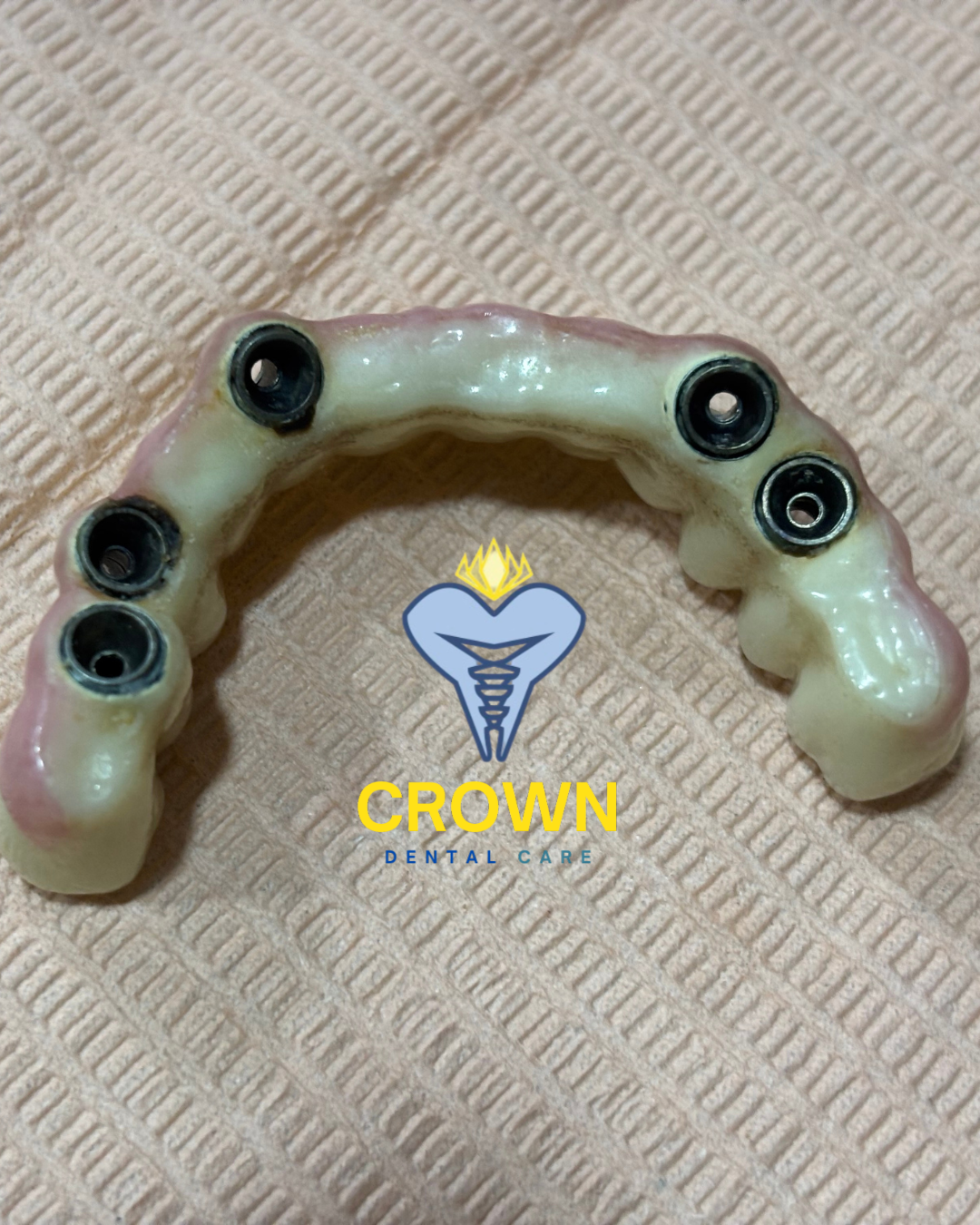
The photograph above shows a precision-engineered DMLS (Direct Metal Laser Sintering) multi-unit implant-supported prosthesis — an arch restoration anchored by multiple osseointegrated implants. It represents the pinnacle of modern restorative dentistry. But no matter how exquisitely crafted, every implant prosthesis shares the same vulnerability as a natural tooth: the tissues around it respond to bacteria, loading forces, and time. Without systematic professional care, even the finest implant work can silently deteriorate. This blog lays out — in the words of current peer-reviewed research — why coming back to see us is not optional.
Ruiz-Romero et al., 2024
Retrospective, King Saud University 2024
Peri-implant Disease Risk Score Study
What happens when patients disappear after loading?
The scenario is distressingly common: a patient receives implants, a beautiful prosthesis is fitted, and the clinical team explains the importance of recall. The patient leaves feeling wonderful. Then life intervenes. Six months pass, then a year, then two. When they finally return, the peri-implant tissues tell a story of silent, progressive disease.
A landmark 2024 study from the University of Barcelona followed patients without regular supportive therapy and found that peri-implant mucositis affected 44.3% and frank peri-implantitis affected 26.1% of these individuals. The key risk factors were a thin keratinized mucosal band and marginal bone remodelling in the first year after loading — both conditions that are detectable and manageable at a recall appointment, but invisible to the patient at home.
"Patients who do not engage in supportive peri-implant maintenance have a higher risk of peri-implantitis. A peri-implant keratinized mucosa less than 2 mm wide and early post-loading bone remodelling are the principal risk factors in this profile."
— Ruiz-Romero V et al., Clinical Oral Investigations, 2024
The research is clear: absence from recall predicts failure
A five-year retrospective study assessing survival and success in implant therapy found what many clinicians have long suspected but now have data to confirm: the association between recall visits and complication rates is powerful, and a lack of professional maintenance directly predicts greater marginal bone loss over time.
Recall visits and bone preservation are directly linked
Analysis of implant-supported restorations over five years demonstrated that patients attending regular recall appointments showed significantly less marginal bone height loss compared to those who did not. The authors concluded that absence from professional maintenance is an independent predictor of bone resorption around implants, regardless of the type of prosthesis used.
Similarly, a 2024 retrospective case-control study at King Saud University Medical City examined the records of patients who had experienced implant failure. Among this group, only 36.4% had attended regular maintenance visits — meaning 63.6% of the patients who lost implants had failed to keep up with professional care. The authors aligned this with the 2017 World Workshop consensus statement, which formally cited irregular maintenance as a significant independent risk factor for peri-implantitis onset.
Important: Peri-implant mucositis — the reversible, early-stage gum inflammation around implants — can progress to peri-implantitis (irreversible bone loss) if left undetected and untreated. A 2024–2025 meta-analysis placed patient-level peri-implantitis prevalence at nearly 22%, with mucositis affecting approximately 43% of implant cases. Most of these cases are preventable.
What does a recall visit actually involve?
A maintenance visit for an implant patient at Crown Dental Care is a structured clinical protocol, not simply a clean and polish. Based on guidelines developed collaboratively by the American College of Prosthodontists, the American Dental Association, and the American Dental Hygienists' Association, our maintenance protocol includes three interconnected components.
Peri-implant clinical assessment
We record probing depths around every implant, check for bleeding on probing (a critical early sign of mucositis), measure keratinized mucosal width, and assess full-mouth plaque scores. These metrics, compared against your baseline records, reveal changes invisible to you at home.
Radiographic bone level check
Retro-alveolar radiographs allow us to compare crestal bone levels against your post-loading baseline. Even one millimetre of unexplained bone loss is a clinical signal that requires prompt investigation. Early detection at this stage is the difference between a simple intervention and complex surgical management.
Professional biofilm debridement
Biofilm at the implant-mucosal interface cannot be fully eliminated by home hygiene alone. We use implant-safe instruments (titanium-tipped curettes, air-polishing with glycine powder, ultrasonic devices with non-metallic tips) to disrupt the submucosal bacterial community that drives peri-implant disease.
Prosthetic component check
For screw-retained restorations like the multi-unit prosthesis pictured, we check screw torque, evaluate the occlusal scheme, and assess the emergence profile — all factors that influence peri-implant tissue health. Loose abutment screws create micromovement and bacterial ingress that accelerates bone loss.
Individualised oral hygiene reinforcement
A 2016 systematic review of 1,088 patients across 20 randomised controlled trials and observational studies confirmed that outcome improvements are strongly linked to specific oral hygiene adjuncts: interdental brushes, water flossers, and chlorhexidine where indicated — along with professional maintenance of the prosthesis itself.
Risk factors that make recall even more critical
Not all implant patients carry the same risk profile. Research consistently identifies specific characteristics that escalate your need for vigilant recall attendance. If any of the following apply to you, please inform our clinical team — your recall interval may need to be shortened to three or four months.
History of periodontitis
A 2024 systematic review and meta-analysis confirmed that a prior history of periodontitis remains one of the strongest predictors of peri-implantitis and implant failure. These patients require more frequent, intensive monitoring.
Current or former smoking
Tobacco use impairs peri-implant vascularisation and mucosal healing. Smokers show accelerated bone loss around implants and have higher rates of treatment-resistant peri-implantitis.
Systemic conditions
Diabetes, cardiovascular disorders, and other systemic conditions are associated with impaired osseointegration and compromised healing at both early and late stages of implant therapy.
Thin keratinized mucosa
A peri-implant keratinized mucosal width below 2 mm was associated with a five-fold increased odds of peri-implantitis in the 2024 Barcelona study. This finding underscores the importance of early mucosal assessment.
What the latest evidence says about recall intervals
For many years, recall intervals for implant patients were borrowed from periodontal maintenance protocols designed for natural teeth. Current research indicates this is insufficient. A comprehensive evidence review proposed that a recall interval of five to six months represents the minimum threshold for successful long-term outcomes in implant dentistry — and this is for lower-risk patients.
Individualised, risk-based recall delivers the best outcomes
A major 2025 systematic review published in a leading periodontology journal — covering 25 studies including 9 randomised controlled trials — found that supportive peri-implant therapy with individualised, risk-based recall intervals consistently improved clinical outcomes including probing depth and bleeding on probing, compared with standard or no maintenance regimens. The message from the evidence is that one-size-fits-all intervals are obsolete; recall scheduling must be tailored to each patient's risk profile.
At Crown Dental Care, we use a structured risk assessment at every recall visit to determine your next recall interval. High-risk patients may be seen every three months; stable, low-risk patients may be safely maintained at six-month intervals. This personalised approach mirrors exactly what the evidence now demands.
The economic logic of recall
We understand that recall visits carry a cost in time and money. But consider the alternative. Treatment of established peri-implantitis is complex, expensive, and uncertain in outcome. The 2024 Korean Academy of Periodontology consensus review openly acknowledges that "outcomes of the various treatments proposed for peri-implantitis are encouraging, but data are still too heterogeneous to draw clear conclusions." In plain terms: once significant peri-implantitis is established, there is no guaranteed fix. Prevention through recall is therefore not simply good medicine — it is sound economics.
"Current guidelines for the maintenance of implant restorations are often based on empiricism rather than evidence. Professional and home care maintenance guidelines are necessary to improve the health of supporting tissues, limit disease processes, and improve the expected longevity of restorations."
— Prevalence of Peri-Implant Diseases, Journal of Clinical Implantology
A word about multi-unit implant-supported prostheses
The DMLS multi-unit prosthesis shown above — with its screw-access channels, metal framework, and pink aesthetic resin — is an engineering marvel. It distributes occlusal forces across multiple implant points in a completely edentulous arch, restoring chewing function and aesthetics with a level of precision that was unimaginable two decades ago.
However, the very design features that make it clinically excellent also make professional maintenance non-negotiable. The screw-access channels must be sealed and periodically checked for integrity. The implant-abutment connections require torque verification. The emergence profile of the prosthesis at each implant must be assessed for biofilm trapping. The patient must be trained — and regularly retrained — to clean effectively beneath the arch. None of this is possible without periodic professional review.
For full-arch implant patients specifically, we typically recommend recall at three-to-four-month intervals for the first year, transitioning to five-to-six-month intervals once stable tissue health is documented.
Our commitment to you
At Crown Dental Care, the day your prosthesis is delivered is not the end of our clinical relationship — it is the beginning of the maintenance phase, which we consider equally important to the implant and restorative phases. Every patient who receives implant treatment at our practice receives a personalised maintenance plan, a recall schedule aligned with their risk profile, and a team that is trained in the most current evidence-based protocols for peri-implant health.
We ask only one thing of you: please keep your recall appointments. Your implants — and your smile — are worth it.
Schedule Your Implant Recall Visit
Whether you are three months post-loading or three years — it is never too late to restart your maintenance protocol. Contact Crown Dental Care today.
Book an Appointment Call Our Cliniccrowndentalcare.in | Bengaluru, Karnataka