
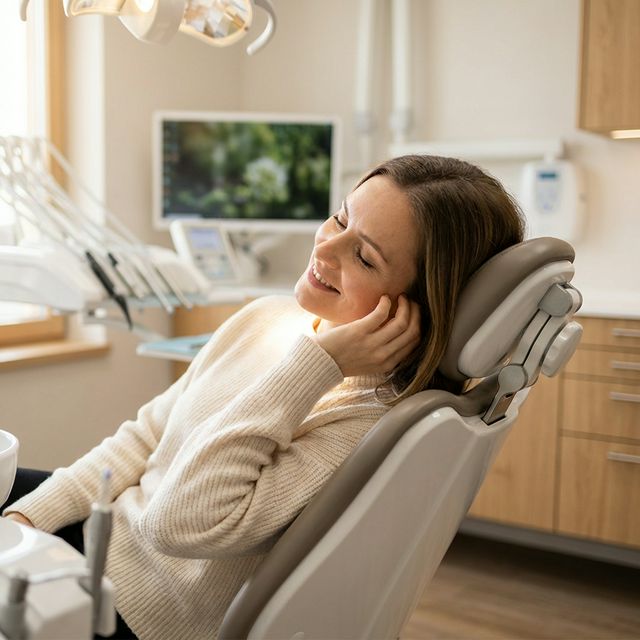
The Day That Made Me Stop Mid-Scaling
Picture this: It's a regular Tuesday morning at Crown Dental Care. My team is prepped, the chair is ready and in walks a patient I'll call 'S.'
She had avoided dentists for years. Years of convincing herself that the anxiety wasn't worth it. It had taken months of gentle nudging from friends and family before she finally reluctantly booked an appointment with me.
The moment she sat in the chair, I could read her body like a textbook: white knuckles wrapped around the armrest, shoulders pulled up to her ears, shallow rapid breathing. Every muscle braced for battle.
Classic dental anxiety. I've seen it a thousand times.
But then something unexpected happened.
The moment I began scaling, she started to hum. Softly. Almost unconsciously. Like a reflex she didn't even know she had.
And within two minutes I watched it happen in real time—her shoulders dropped. Her grip on the armrest loosened. Her breathing slowed and deepened. The tension visibly melted out of her body.
I paused, instruments in hand, and asked: "Do you know why you're humming?"
She blinked, almost surprised by the question. "I don't know... it just helps," she said.
She had absolutely no idea how profoundly correct she was.
What Is Actually Happening When You Hum?
Let me introduce you to the star of this story: the Vagus Nerve.
It is the longest cranial nerve in your body—a biological superhighway that runs from your brainstem, winds through your neck and chest, and reaches all the way down to your gut. It is the master controller of your parasympathetic nervous system—the system responsible for calm, healing, and recovery.
Here is the fascinating part: the vagus nerve has direct branches connected to the muscles of your throat and larynx. When you hum, the gentle vibrations physically stimulate those vagal branches sending an immediate signal to your brain that says:
"You are safe. Stand down."
It is your body's most ancient and accessible off-switch for stress.
What Does the Science Say?
This isn't just poetic biology—the research is compelling:
- Improved Vagal Tone: Studies in Applied Psychophysiology and Biofeedback show that vocal vibration improves vagal tone—the measure of how efficiently your vagus nerve functions. Higher vagal tone = better stress resilience.
- Brain Activation: Research shows that humming activates the nucleus tractus solitarius, the brain's primary relay station for vagal sensory signals, rapidly shifting the body from sympathetic (fight-or-flight) to parasympathetic (rest-and-digest) dominance.
- Physiological Benefits: Documented outcomes include: lower cortisol (the stress hormone), reduced heart rate and blood pressure, decreased pain perception, and improved emotional regulation.
- Anxiety Reduction: A landmark study in the International Journal of Yoga highlighted how humming breath practices (Bhramari Pranayama) significantly reduce anxiety scores and autonomic stress markers within minutes.
Think about that. Within minutes. No medication. No sedation. Just the act of humming.
This is also why ancient traditions—from Vedic chanting to Buddhist mantras to Gregorian chanting in churches—have used sustained vocal tones for thousands of years as healing rituals. Our ancestors understood something neurologically profound long before we had fMRI machines to measure it.
Why This Matters More Than You Think
Dental anxiety is not a small problem. Studies estimate that over 36% of people experience dental anxiety, and up to 12% suffer from dental phobia so severe they avoid treatment entirely even when in pain. This avoidance has serious consequences: untreated infections, worsening oral health, systemic complications, and a devastating cycle of fear.
As dental professionals, we are trained in anesthetics, sedation protocols, and pain management. But we rarely talk about the simplest, most accessible tool available to us: Permission.
The permission to tell a frightened patient: "It's okay to hum." No syringe. No cost. No side effects. Just the extraordinary power of biology doing exactly what it was designed to do.
The Ending That Made My Week
By the time 'S' was done with her scaling, she was laughing. Laughing about how terrified she had been walking in. Laughing at the idea that she had avoided this for years. Laughing because it had actually been fine.
As she got up to leave, she paused at the door and said: "I'll actually come back next time." Six words. And they made my entire week.
That is why we do this work. Not just to clean teeth—but to change the relationship people have with their own health. To meet them where they are, fear and all, and help them discover they are more capable of calm than they ever believed.
A Note for Fellow Dental Professionals
The next time you have an anxious patient gripping your armrest before you reach for anything else try saying these words:
"You can hum if it helps. A lot of people find it calming."
Watch what happens. You may be surprised. The mouth is our gateway to overall health. But the nervous system is the gateway to healing. And sometimes, the most powerful clinical intervention is a soft, steady hum.
Try It Yourself: Right Now
Yes, you. Before you scroll past this. Close your mouth. Take a deep breath in. And on the exhale, hum. A long, low, steady tone.
Feel that vibration in your chest, your throat, your face? That is your vagus nerve being gently activated. That is your parasympathetic system waking up. That is centuries of healing wisdom, confirmed by modern neuroscience, available to you—for free—in this exact moment.
You already have everything you need to begin to heal.
Ready to experience dental care that sees the whole you?
Book your appointment at Crown Dental Care